Eating Patterns
The Pattern Behind the Plate: Eating Rhythms and Long-Term Weight
Eleanor Whitfield
·
Portion thinking is often presented as an exercise in restraint. In practice, it is closer to an exercise in attention — a quiet consideration of what a plate communicates about the priorities of the person who assembled it. To look carefully at a plate is not to count; it is to notice the proportions that have been chosen, consciously or otherwise, and to ask what those proportions tend to produce over time.
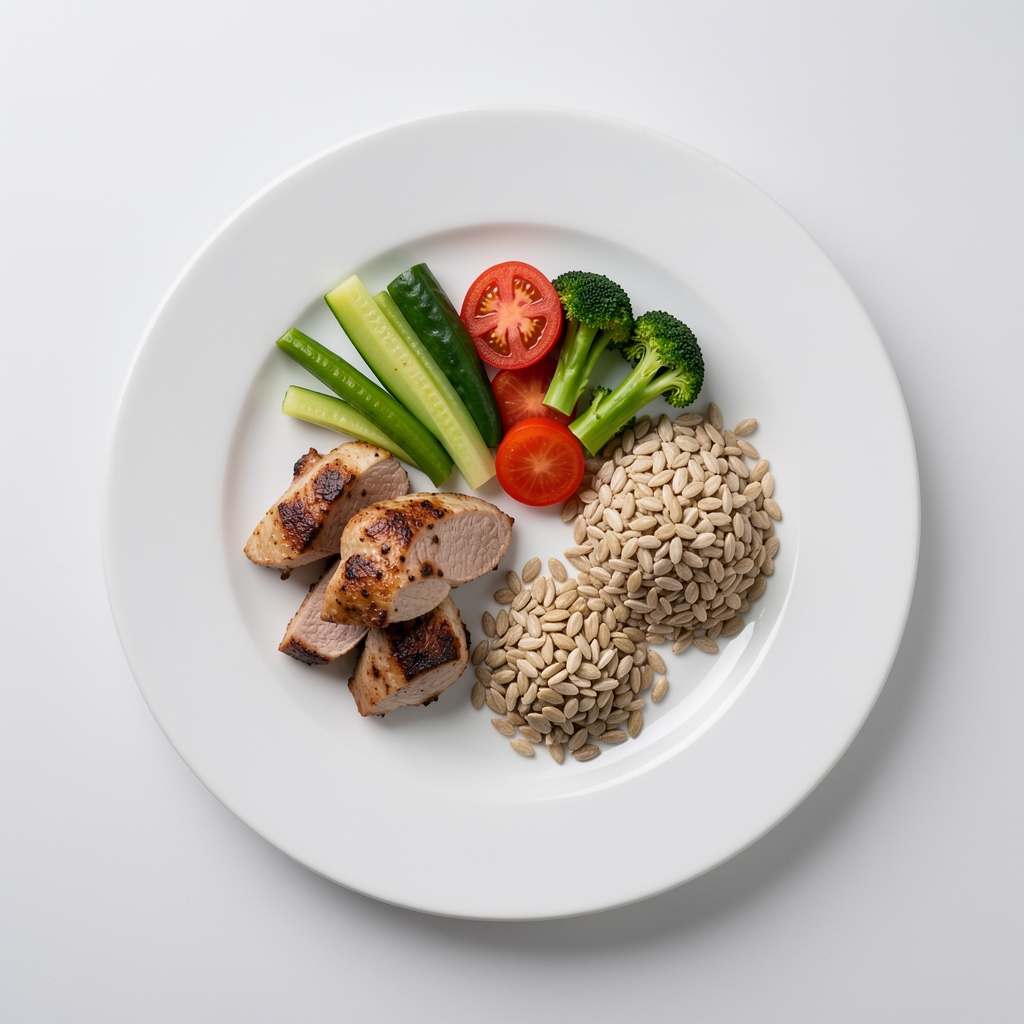
There is a kind of geometry to a well-assembled plate that has nothing to do with weighing scales or calorie counters. When nutritional researchers attempt to communicate the practical implications of their findings to a general audience, the metaphor they most reliably reach for is the plate — divided into approximate sectors of vegetables, protein, and carbohydrate, with the relative sizes of those sectors carrying the essential message.
The appeal of this framing is that it is spatial rather than numerical. It operates at the level of visual recognition, which is how most people actually navigate the experience of eating. A plate that is predominantly occupied by vegetables and a palm-sized portion of protein, with a modest quarter assigned to whole grain carbohydrate, presents a different nutritional proposition from one that is half carbohydrate, a third protein, and a sixth vegetable — even if the calorie count between them is similar, the experience of fullness, the fibre content, and the rate of energy absorption will differ meaningfully.
This distinction is not about virtue or discipline; it is about the nutritional geometry of what happens to a plate when food quality and food proportion are considered together. The balanced plate approach, as it is sometimes described, is less a set of rules than an observational framework — a way of noticing what a particular eating pattern tends to produce, and adjusting the proportions accordingly.
The reductive framing of portion control as calorie management has, over several decades, generated a counterproductive relationship with eating for many people. When portions are experienced as imposed restrictions — ceilings on permissible intake — the response is typically a form of oscillation: periods of stringent reduction followed by periods of what is sometimes called compensation eating, in which the bodily experience of scarcity generates its own urgency.
A more useful framing is attentional rather than arithmetic. To develop portion perspective is to cultivate a practised sense of what different quantities of food look like on a plate, and what they tend to produce in terms of fullness, energy, and satisfaction. This is a skill that is acquired through familiarity rather than calculation — the accumulated experience of noticing how a particular quantity of a particular food feels, not just immediately but over the subsequent two or three hours.
This attentional approach is particularly relevant in the context of high-calorie-density foods, which are foods that pack a significant number of calories into a small physical volume. Nuts, oils, cheeses, and dense grain products all fall into this category. Portion perspective does not require avoiding such foods — it requires noticing their density and adjusting the proportions of a plate accordingly, in the same way that a person might instinctively moderate the quantity of a very rich sauce without needing to measure it.
"A plate assembled with attention is not necessarily a plate assembled with restraint. The aim is not less — it is a different quality of composition."Harriet Beaumont, Tarlone Quarterly
Protein occupies a distinctive position in the portion equation because of its unusually strong relationship with satiety. Of the three macronutrients, protein has the highest thermic effect — meaning that the body expends more energy processing it than it does fat or carbohydrate — and it produces the most sustained satiety signal, largely through its influence on the release of hunger-moderating compounds including peptide YY and GLP-1.
In practical portion terms, this means that a plate with an adequate protein component — typically a palm-sized or quarter-plate serving of a protein-rich food such as fish, legumes, eggs, or meat — tends to produce a longer period of satisfied fullness than a plate of equivalent calorie content that is protein-light. The satiety contribution of protein is not unlimited, and at very high intakes the marginal additional fullness effect diminishes, but across the range of portions that most people consume, protein content is consistently among the most reliable predictors of how long a meal keeps hunger at bay.
The practical implication is straightforward: a plate that has been assembled with sufficient protein, adequate fibre from vegetables and whole grains, and modest quantities of higher-calorie-density components, tends to require no further management in terms of portion restriction. The combination itself does the work that explicit restriction attempts to impose from the outside — not through deprivation, but through the biological logic of what happens to appetite when all three satiety mechanisms are engaged simultaneously.
One of the more significant findings in behavioural nutritional research is the degree to which portion size is determined not by internal hunger signals but by the external containers and serving conventions of a given eating environment. When food is presented in larger vessels — plates, bowls, glasses, serving spoons — people consistently eat more of it, and they do not consistently report feeling fuller afterwards. The portion, in other words, has been silently expanded by the environment, and the internal signal has not compensated for it.
This phenomenon — sometimes called portion distortion — has been steadily amplified over recent decades by increases in the standard serving sizes of restaurant meals, ready-prepared foods, and takeaway containers. The reference point for what constitutes a normal portion has drifted upwards, and with it the baseline from which people calibrate their own eating. A person who eats from a large plate and fills it to approximately the same visual density as a smaller plate will consume more food, and will feel equally satisfied — because satisfaction, in the short term, is more responsive to visual completion norms than to precise physiological need.
Developing an independent portion perspective — one that is calibrated to internal signals rather than container conventions — is therefore not simply a matter of willpower or nutritional knowledge. It involves a degree of active awareness of the environmental defaults that are shaping the eating decisions, and a willingness to depart from them when necessary. This does not require dramatic changes; the research on plate size and serving vessel manipulation suggests that modest reductions in the physical scale of the eating environment produce meaningful changes in intake over time, without generating any subjective experience of restriction.
What matters in the relationship between portion habits and long-term weight is not any particular meal, but the accumulated character of many thousands of meals across years. The person who habitually assembles a plate that is mostly vegetables and adequate protein, with a modest carbohydrate component, is doing something nutritionally different from the person who habitually assembles a plate that is mostly refined carbohydrate with modest protein and minimal vegetable content — and the difference accumulates over time in ways that are not perceptible in any single instance.
Portion perspective, practised consistently over time, becomes a form of eating literacy: an ability to read a plate and understand something about what it is likely to do, not because every meal has been calculated, but because the attentional practice of assembling meals thoughtfully has produced a reliable intuition. This is how most people who maintain a stable, healthy weight over many years actually operate — not through continuous counting, but through a practised awareness of proportion that has become habitual.
Tarlone Quarterly returns regularly to this theme of the habitual and the structural in eating, because these are the dimensions of food and weight that most reward sustained editorial attention. The dramatic and the immediate are well-served by other publications. What is less well-served is the reader, observational consideration of what a year's worth of ordinary plates is likely to produce — and that is where this publication's interest is most genuinely placed.

Harriet Beaumont is a writer and editor whose work examines food habits, eating culture, and the practical dimensions of nutritional literacy. She contributes to Tarlone Quarterly on topics related to portion habits and the everyday construction of meals.
More from this publication →