
Eating Patterns
The Pattern Behind the Plate: Eating Rhythms and Long-Term Weight
Eleanor Whitfield
·
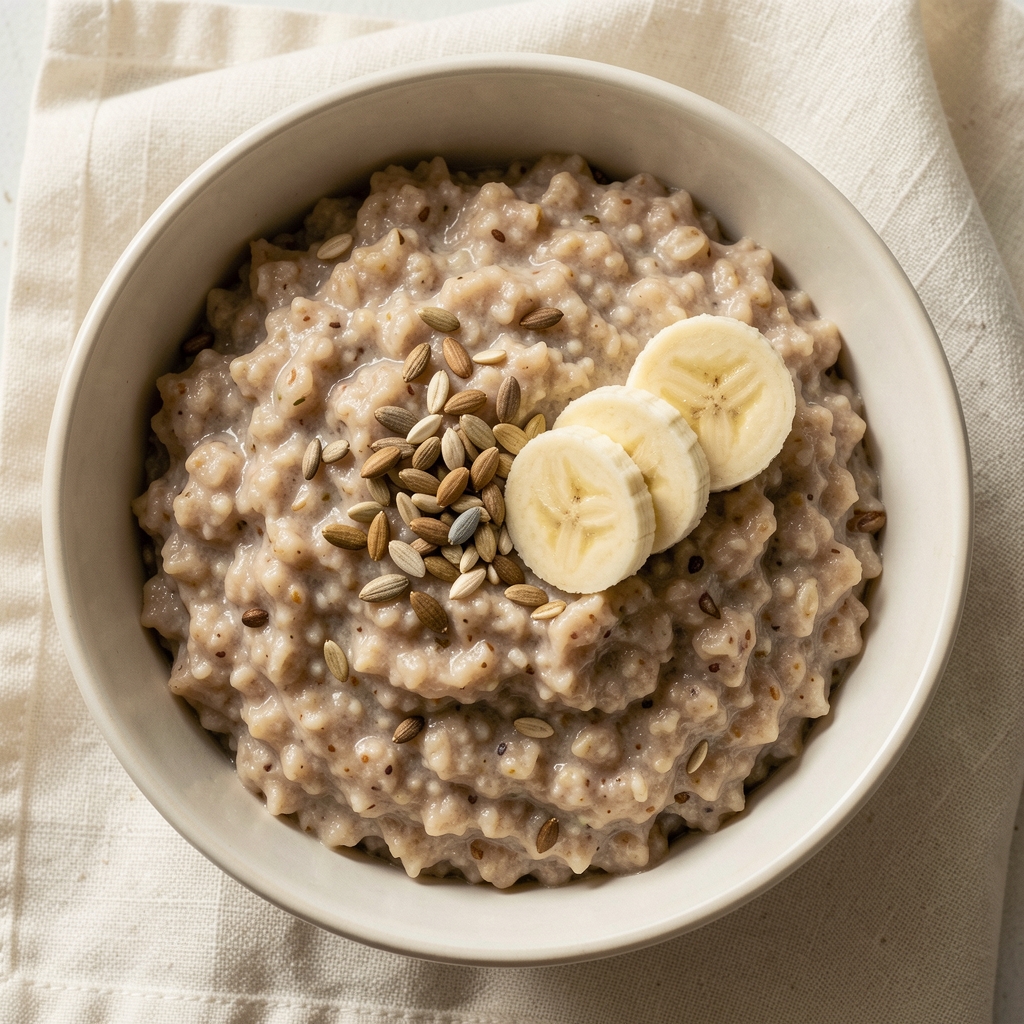
The conversation about whole grains rarely begins where it should — with the mechanism of fullness. When a grain retains its bran and germ, it carries with it a fibre structure that engages the body's hunger signals quite differently from its refined counterpart. This is not a nutritional detail; it is the central fact around which much of the practical argument rests.
A grain kernel, in its whole form, is composed of three distinct layers: the outer bran, the inner germ, and the starchy endosperm that forms the bulk of the seed. When a grain is refined — as in the production of white flour or white rice — it is the bran and germ that are removed, retaining the endosperm almost exclusively.
What leaves with the bran and germ is not trivial. The bran is the grain's primary source of dietary fibre, both soluble and insoluble. The germ contributes B vitamins, Vitamin E, iron, and zinc. The endosperm, by contrast, is almost entirely starch — rapidly digestible, with a comparatively high impact on the body's blood glucose response and a much weaker relationship with satiety signalling.
This structural loss has practical consequences. A breakfast based on refined grain will, for most people, produce a shorter period of fullness than an equivalent portion of whole grain. Not because of willpower or discipline — but because of the biological sequence that fibre sets in motion. The same calorie count delivers a materially different internal experience, and this distinction sits at the heart of the whole grain argument.
Dietary fibre operates through several overlapping mechanisms, each of which contributes to the longer-lasting experience of fullness that whole grains tend to produce. The most immediate is physical: insoluble fibre adds bulk to the contents of the stomach, triggering stretch receptors that signal to the brain that capacity is being approached. This is a relatively coarse but effective signal, and it tends to arrive earlier in a meal than the physiological signals that follow.
Soluble fibre, by contrast, does much of its work in the small intestine and colon. On contact with water, it forms a gel-like consistency that slows the rate at which food moves through the digestive tract. This deceleration has a measurable effect on the speed at which carbohydrates are absorbed — flattening what would otherwise be a sharp rise in blood glucose and the subsequent insulin response that, in its rapid decline, can leave a person hungrier than they were before eating.
The slower digestion enabled by soluble fibre also prolongs the release of certain satiety-signalling compounds, including peptide YY and glucagon-like peptide-1. These are the molecules that carry the message of fullness from the gut to the brain, and their sustained presence over a longer postprandial window is part of why a whole grain breakfast tends to keep hunger quieter for longer — not in a dramatic or sudden way, but in the modest, cumulative manner that has the most practical relevance for daily eating habits.
"It is not that whole grains suppress appetite — it is that they extend the window in which hunger remains absent. That distinction carries real weight in a day's eating."Tobias Marsden, Tarlone Quarterly
One of the complications in writing about whole grains as a category is that the category encompasses an extraordinary variety of foods, each with a distinct fibre profile, glycaemic character, and practical role in cooking. Rolled oats, pearled barley, buckwheat, rye, freekeh, spelt, whole wheat, and millet share the defining characteristic of intact structure — but they behave quite differently in the body and in the kitchen.
Oats, for example, are particularly high in beta-glucan, a form of soluble fibre that has one of the strongest documented relationships with post-meal fullness and with the moderation of blood glucose response. Barley shares this characteristic, and indeed contains even higher levels of beta-glucan by weight. Whole wheat, in contrast, is higher in insoluble fibre, with a different contribution to gut transit speed and a somewhat different satiety profile.
The practical relevance of this diversity is simply that not all whole grain choices are equivalent, and the argument for whole grains over refined grains is strongest when it is made at the level of eating patterns rather than individual foods. A person who occasionally eats white rice alongside a varied whole-grain-rich diet is not undermining any nutritional logic. The structural effect of fibre on fullness and eating rhythm plays out over weeks and months, not across a single meal.
Despite the well-established relationship between dietary fibre and a range of positive nutritional outcomes, including its contribution to the experience of satiety, the average fibre intake in the United Kingdom falls significantly short of the recommended 30 grams per day. Survey data consistently places average adult intake closer to 18–20 grams — a shortfall that has practical implications for how people experience hunger throughout the day.
This is not a figure that carries particular moral weight. It is, rather, an observation about the typical character of the modern food environment, in which refined grains are structurally more available, more affordable, and more deeply embedded in familiar recipes than their whole counterparts. The gap between current and recommended fibre intake is a product of food system architecture as much as individual preference.
For those who wish to close that gap, whole grains offer one of the most straightforward pathways — though not the only one. Legumes, vegetables, and fruits all contribute meaningfully to fibre intake, and in the context of a varied, plant-rich eating pattern, whole grains function as one part of a broader nutritional picture rather than as a single solution to a singular deficit. The argument, in the end, is not that whole grains are exceptional — it is that their structural properties are consistently and quietly useful.
The conversation about whole grains and weight cannot be separated from a parallel conversation about what tends to displace them in the typical Western eating pattern: refined grain products that are also high in added sugar. A biscuit made from white flour and sugar presents a very different nutritional proposition from a bowl of oat porridge, even if the calorie counts are arranged to be equivalent. The absence of fibre, combined with the rapid absorption of refined starch and free sugar, creates a post-meal blood glucose arc that is fundamentally at odds with stable, sustained fullness.
The role of sugar in weight management is a topic that attracts more polemical attention than it perhaps warrants. Sugar does not operate in isolation; its effects on satiety and eating rhythm are shaped by the broader context of a meal — the presence or absence of protein, the fibre content of accompanying foods, the overall pace of eating. What the nutritional literature suggests is not that sugar is uniquely harmful, but that its pervasive presence in processed grain products tends to accompany the removal of the very structural elements — fibre, protein, bran — that would otherwise support a more stable hunger response.
Whole grain choices, by comparison, typically arrive in a less processed form, with their fibre intact and their sugar content either absent or modest. This structural coherence is, in the end, the most straightforward case for them: not that they are exceptional foods, but that they carry with them the elements that make eating a less urgent and more settled affair across the course of a day.

Tobias Marsden is a contributing editor at Tarlone Quarterly with a background in nutritional science writing. His work focuses on the intersection of food quality, eating structure, and the practical experience of satiety.
More from this publication →